
Coin-Operated Pool Tables: How a 7ft Bar Table Works and What Buyers Should Check
A practical guide to the payment mechanism, ball return, slate, cushions, maintenance and commercial planning behind a self-service bar pool table.
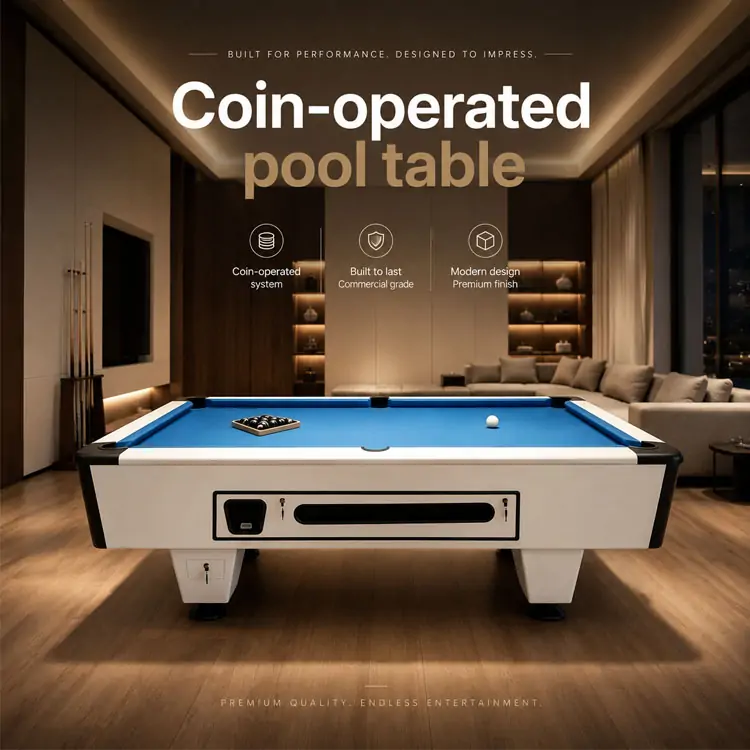
A coin-operated pool table is more than a smaller American pool table with a payment slot. It is a self-service system: the cabinet must collect balls reliably, separate or return the cue ball, release a new rack after payment and remain easy to service during busy operating hours.
For bars, pubs, arcades, family entertainment centers, hotels and staff recreation spaces, a well-specified 7ft coin-operated pool table can turn limited floor space into a repeat-play attraction. For distributors, it can also become a market-specific product when the coin mechanism, finish, cloth and branding are properly customized.
This guide explains how the system works, why the 7ft format is popular, and what a commercial buyer should confirm before ordering.
Quick Answer: What Is a Coin-Operated Pool Table?
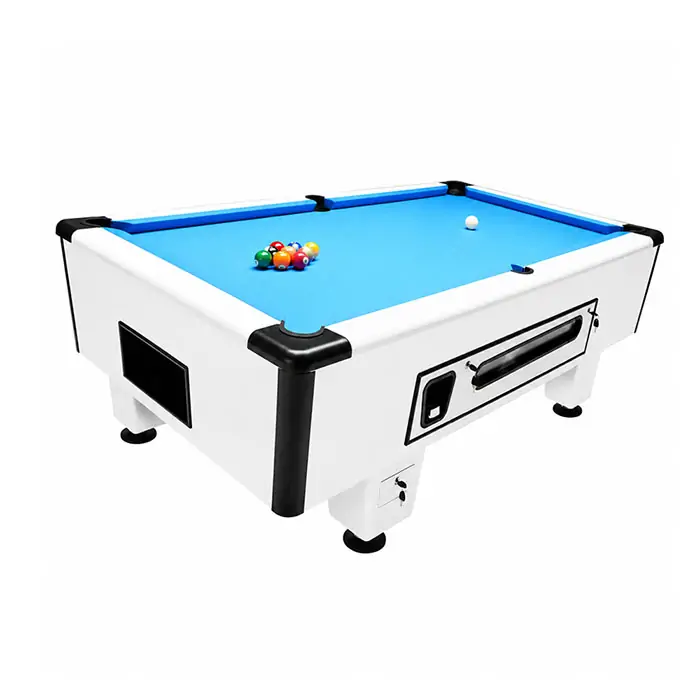
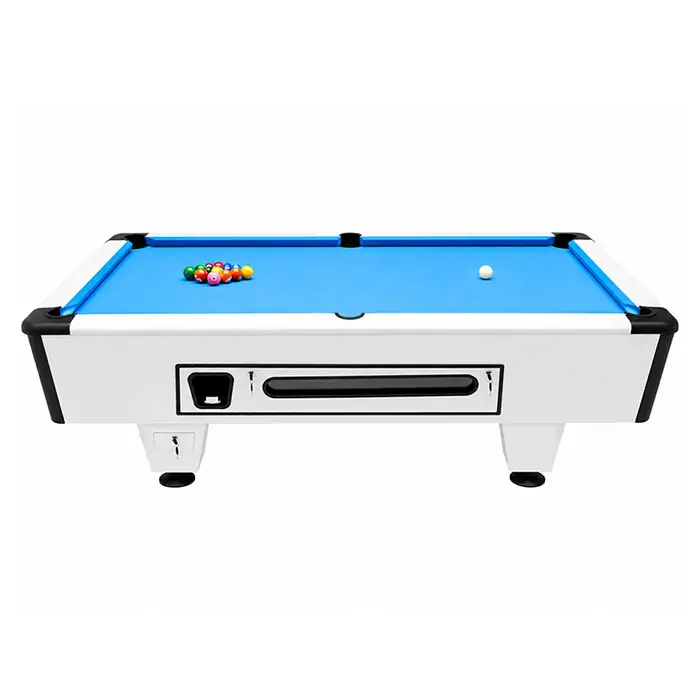
A coin-operated pool table stores the object balls inside the cabinet after they are pocketed. When a player inserts an accepted coin or token, the mechanism releases the collected balls to the access tray for the next game. The cue ball follows a separate return path so play can continue after a scratch.
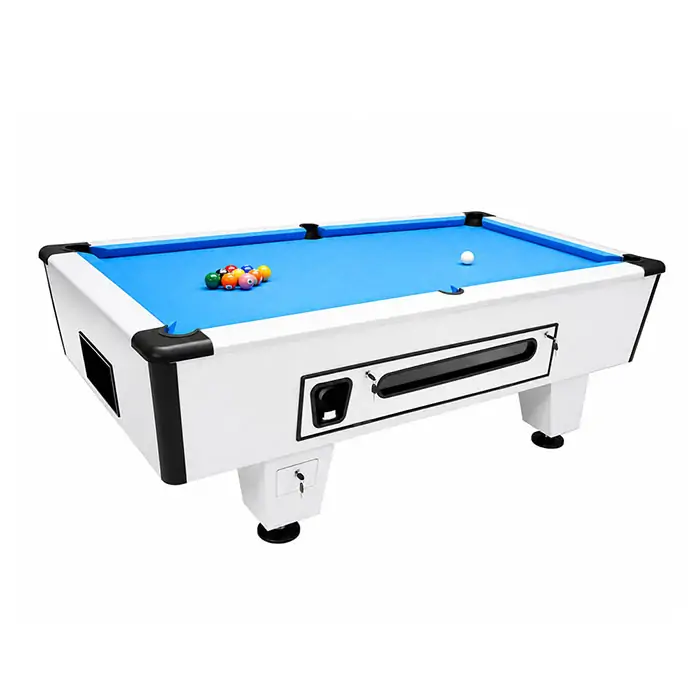
The strongest commercial table is therefore a combination of four systems:
- A level and predictable playing surface
- Consistent cushions and pocket geometry
- A dependable ball collection and return path
- A secure, serviceable payment mechanism
If any one of these systems is poorly designed, the operator faces customer complaints, lost playing time or unnecessary staff intervention.
Why 7ft Is the Commercial Sweet Spot
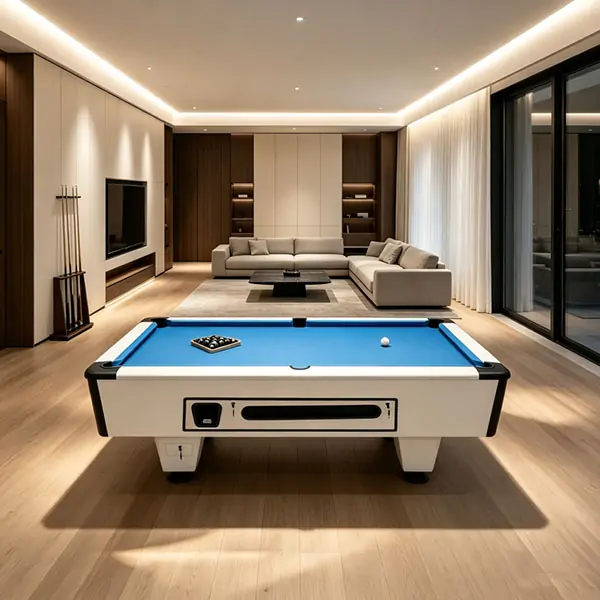
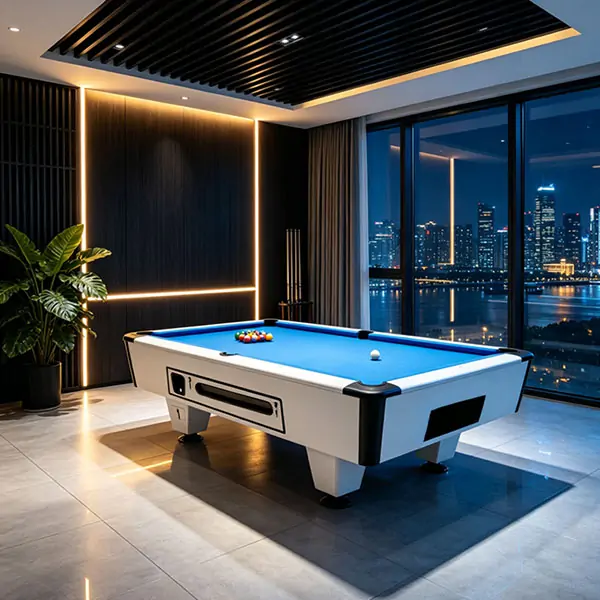
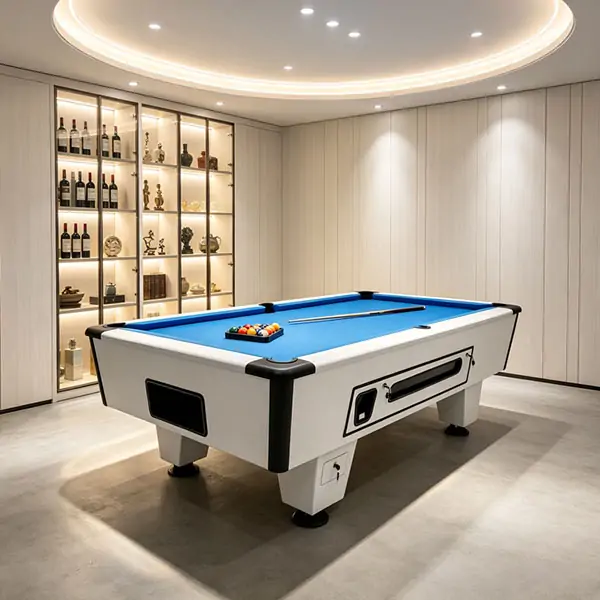
Seven-foot American pool tables are often called bar tables or bar boxes. Their compact playing field creates shorter games, keeps the experience approachable for casual players and leaves more room for seating and circulation.
The smaller footprint is especially useful where every square meter must contribute to the venue. A 7ft table can fit locations that cannot comfortably accommodate a full 9ft competition-style table, while still providing familiar 8-ball and 9-ball play.
A 7ft coin-operated model is a strong fit for:
- Bars, pubs and nightlife venues
- Arcades and family entertainment centers
- Bowling centers and sports clubs
- Hotels, resorts and holiday parks
- Staff canteens and recreation rooms
- Distributors building a private-label commercial range
The decision should still begin with the room. Ask for the exact playing-field and overall dimensions, then allow cue clearance, player circulation, seating and access to the coin door.

How the Coin and Ball-Return System Works
During a game, pocketed object balls travel through internal channels into a locked collection area. The cue ball is identified by the table’s separation system and directed to an accessible return. After the game, inserting the accepted coin or token activates the release mechanism and sends the object balls to the ball tray.
Before ordering, specify the local payment format. Coin diameter, thickness, weight and denomination vary by market. A venue may also prefer proprietary tokens because they simplify promotions, prevent foreign-coin use and give the operator control over game pricing.
Ask the supplier to confirm:
- Which coin or token dimensions the mechanism accepts
- Whether the price per game can be changed on site
- How the cash box is locked and removed
- How the cue ball is separated from object balls
- How staff access the ball channels when a blockage occurs
- Which mechanism and return-system spare parts are included
BOJUE lists a customizable coin mechanism on its 7ft commercial table, allowing buyers to define the coin or token format for the destination market.
BOJUE 7ft Coin-Operated Table: Listed Configuration
| Component | BOJUE pool table specification | Why it matters |
| Table format | 7ft American-style commercial table | Compact footprint and faster games |
| Playing bed | 25 mm, three-piece Jiujiang Grade-A natural slate | Supports flatness and on-site precision leveling |
| Cushions | Premier K55 commercial-grade rubber | Provides familiar American-pool rebound geometry |
| Cushion rails | Solid Thai oak with HPL surface | Combines structural support with wear resistance |
| Frame | Solid Thai oak | Supports the slate and cabinet assembly |
| Apron and leg beam | Plywood construction | Commercial cabinet structure |
| Legs | Wood, height adjustable | Helps installers level the table on uneven floors |
| Payment | Customizable coin or token slot | Adapts the table to local operating models |
| Ball handling | Internal object-ball collection and cue-ball return | Enables self-service play |
| Custom options | Coin design, color, cloth and logo; OEM/ODM | Supports venue identity and private-label orders |
These are BOJUE’s current website-listed specifications. Final dimensions, finish, bill of materials, accessories and electrical requirements, if any, should be confirmed on the approved sales drawing and pro forma invoice.
Why Slate and Leveling Still Matter on a Bar Table
Commercial convenience should not come at the expense of ball roll. A natural-slate bed provides a rigid reference surface, while the three-piece format is practical for export shipping and access through commercial buildings.
The finished result depends on installation. Each slate section must be supported, leveled and aligned so the seams behave as one plane. Adjustable legs help establish the cabinet level, but they do not replace detailed slate leveling.
When comparing quotations, ask whether the supplier provides:
- A matched, serialized slate set
- Leveling points or shims appropriate to the frame
- Assembly drawings and installation instructions
- Cloth-fitting guidance
- Recommended tolerances and a final roll test
The installer should test slow rolls in multiple directions. A ball that consistently drifts near one end or one rail indicates that further leveling is required.
K55 Cushions and HPL Rails for Commercial Use
K55 describes a cushion profile widely associated with American pool. The profile alone is not a performance guarantee: rubber compound, rail height, bonding and nose alignment all affect rebound.
BOJUE lists Premier K55 cushions and solid Thai oak rails on this model. The HPL surface protects frequently touched areas against chalk, moisture and routine cleaning. This is useful in public venues, where a pristine furniture finish can become costly to maintain.
Before approving production, test or request evidence of:
- Even rebound along every rail
- No dead spots, rail buzz or loose sections
- Consistent cushion-nose height
- Clean HPL edges and protected corners
- Replaceable cushion and rail components
Planning Revenue Without Making Unrealistic Promises
A coin-operated table can support paid play, but no supplier can guarantee revenue. Location, foot traffic, opening hours, price, local competition, table condition and promotion all influence the result.
Use a simple planning formula:
Estimated gross game revenue = paid games per day x price per game x operating days
Build conservative, expected and busy-day scenarios. Then subtract taxes, payment losses, staff time, cloth and cushion wear, spare parts, cleaning, rent allocation and depreciation. This makes the table part of a business plan rather than a marketing promise.
Operators can improve utilization by placing the table where it is visible, keeping cues and balls in good condition, running league or challenge nights, and using tokens for bundles or customer rewards.
Commercial Maintenance Checklist
Self-service does not mean maintenance-free. A short routine protects playing quality and reduces downtime.
Daily
- Brush or vacuum the cloth using the cloth supplier’s approved method.
- Remove chalk and spills from rails and cabinet surfaces.
- Confirm that the cue ball and object balls travel to the correct returns.
- Check cues, racks and balls for damage.
Weekly
- Inspect pocket liners and internal ball channels.
- Empty and secure the cash box according to venue procedure.
- Test several accepted coins or tokens.
- Check table level with controlled slow-roll tests.
Periodically
- Inspect cushion response and rail fasteners.
- Clean the internal return system.
- Replace worn cloth, pocket parts and balls.
- Review game price and token control.
- Keep common mechanism parts and keys in a documented location.
Service access should remain clear after installation. Do not position fixed furniture against a coin door, ball tray or maintenance panel.
What Distributors and OEM Buyers Should Specify
A distributor should convert customization into a controlled product specification. Define the accepted coin or token, cabinet color, cloth brand and color, logo artwork, lock type, accessories, packaging labels and spare-parts kit.
For the first order, request:
- Approved dimensional and appearance drawings
- A sample or video test of the configured payment mechanism
- Ball-separation and return testing
- Packaging and container-loading information
- Assembly manual and replacement-parts list
- Warranty terms and service process
BOJUE’s website lists color, cloth, logo and coin-mechanism customization together with OEM/ODM support. These options are most valuable when every approved detail is recorded before mass production.
Final Buying Recommendation
Choose a 7ft coin-operated pool table when compact use, casual play and self-service operation are central to the project. Prioritize the reliability of the payment and return systems just as highly as slate, cushion and frame construction.
The BOJUE model combines a customizable coin or token mechanism with 25 mm three-piece natural slate, Premier K55 cushions, solid Thai oak structural elements, HPL rail protection and adjustable legs. Buyers should confirm the exact local coin specification, room drawing, final finish, accessories, installation plan and spare-parts package in writing.
View the [BOJUE 7ft Coin-Operated Pool Table] or [contact BOJUE] for venue, distribution and OEM quotations.
Frequently Asked Questions
- How does a coin-operated pool table return the cue ball?
The table uses a separation system to route the cue ball to an accessible return while storing object balls inside the cabinet until the next payment. The exact separation method should be confirmed for the model and ball set. - Can a coin-operated pool table use custom tokens?
Yes. BOJUE lists a customizable coin mechanism. Buyers should provide the required coin or token diameter, thickness, weight and acceptance rules before production. - Is a 7ft table suitable for a bar?
Yes. Its compact footprint, quicker games and familiar American-pool format make 7ft a practical commercial choice. The final room plan must still provide cue clearance and service access. - Does a coin-operated table need slate?
Slate is not required for the payment function, but a correctly installed natural-slate bed supports flatter, more predictable ball roll and professional serviceability. - Can BOJUE customize the cloth and logo?
BOJUE’s product page lists custom color, cloth, logo and coin design, plus OEM/ODM support. Confirm MOQ, lead time and the approved sample directly with the factory.