

How to Choose an American Pool Table?
AMERICAN POOL TABLE BUYER’S GUIDE
7ft vs 8ft vs 9ft, Slate, K55 Cushions and Commercial Use
A practical specification guide for homes, clubs, bars, hotels, distributors and OEM buyers
An American pool table can be a home-game centerpiece, a revenue-generating machine in a bar, or the foundation of a serious billiard club. Those buyers may all search for the same product, but they should not buy the same specification.
The right decision starts with five questions: How much room is available? Who will play? How many hours will the table operate each day? Is tournament-style play important? And does the buyer need custom branding, a ball return or a coin mechanism?
This guide explains how to choose between 7ft, 8ft and 9ft American pool tables, what slate and K55 cushions contribute to playability, and which construction details matter most for homes, clubs, bars, hotels, distributors and OEM buyers.
Quick Answer: Which American Pool Table Size Should You Buy?
| Size | Best suited to | Playing-field reference | Buying priority |
| 7ft | Bars, pubs, compact game rooms, coin operation | Varies by model; confirm before ordering | Space efficiency and fast game turnover |
| 8ft | Homes, hotels and mixed-use recreation rooms | WPA reference: 92 x 46 in | Balance between room fit and serious play |
| 9ft | Billiard clubs, academies and competition-focused venues | WPA reference: 100 x 50 in | Full-length shot making and tournament-style practice |
For most commercial clubs, a 9ft table is the strongest long-term choice. For a home that cannot comfortably fit a 9ft model, an 8ft table is usually the best compromise. A 7ft table is the practical choice when space, customer turnover or self-service revenue matters more than competition-scale practice.


What Defines an American Pool Table?
American pool tables are designed for games such as 8-ball, 9-ball, 10-ball and straight pool. They normally use 57.2 mm balls, six open pockets, fast cloth and rail geometry that accepts a wider range of shots than a rounded-jaw Heyball or snooker table.
The defining experience is not only pocket size. A well-built American table combines:
- A flat, stable playing bed
- Responsive cushions with consistent bank angles
- A rigid frame that holds its level
- Correct pocket geometry
- Durable rail and apron finishes
- Cloth matched to the speed and usage of the venue
- Reliable drop-pocket, ball-return or coin-operated hardware
The result should be predictable. The same shot, played with the same speed and spin, should produce the same roll and rebound anywhere on the table.
7ft vs 8ft vs 9ft Pool Tables
Choose a 7ft pool table for compact, high-turnover venues
A 7ft American pool table is often called a bar box. Its shorter playing field creates faster racks and keeps the game accessible to casual customers. It also leaves more seating and circulation space in a pub, family entertainment center or small game room.
For commercial operators, the strongest argument for 7ft is operational efficiency. A coin-operated table can collect payment without staff intervention, automatically manage the balls and support steady play throughout the day. BOJUE’s Coin-Operated 7ft Pool Table is designed for this self-service use case and offers a customizable coin mechanism for different markets.
Choose 7ft when:
- Floor space is limited.
- The venue serves mostly casual players.
- Fast games and customer turnover are priorities.
- Coin operation or self-service is required.
- The table must be easy to position within an existing entertainment layout.
Because 7ft playing-field dimensions can vary, always ask for the exact cushion-to-cushion measurement before planning the room.
Choose an 8ft pool table for a versatile home or hospitality space
An 8ft table offers a useful middle ground. It provides longer shots and more realistic positional routes than a 7ft table, while fitting rooms that cannot comfortably accommodate a full 9ft model.
The WPA recommended equipment specification lists an 8ft playing surface of 92 x 46 inches, measured inside the cushions. Commercial and home models can vary, so the supplier’s drawing should remain the final planning reference.
An 8ft table makes sense for:
- Private game rooms
- Hotels and resorts
- Residential developments and clubhouses
- Offices and staff recreation areas
- Venues serving both beginners and experienced players
BOJUE’s American Classic 6th Gen is offered in 8ft and 9ft configurations, giving buyers a consistent design language across different room sizes.
Choose a 9ft pool table for professional and competition-focused play
A 9ft table is the standard reference for serious American pool. The WPA recommended equipment specification defines the 9ft playing surface as 100 x 50 inches. The larger field demands a straighter stroke, more precise speed control and stronger positional planning.
For a billiard club, training academy or event venue, the 9ft table does more than make the game harder. It gives serious players the conditions they expect and supports competitive 8-ball, 9-ball and 10-ball programming.
BOJUE’s 9ft range includes traditional solid-wood designs, steel-framed commercial workhorses and visually distinctive LED models. This lets buyers select for playing performance without forcing every venue into the same aesthetic.
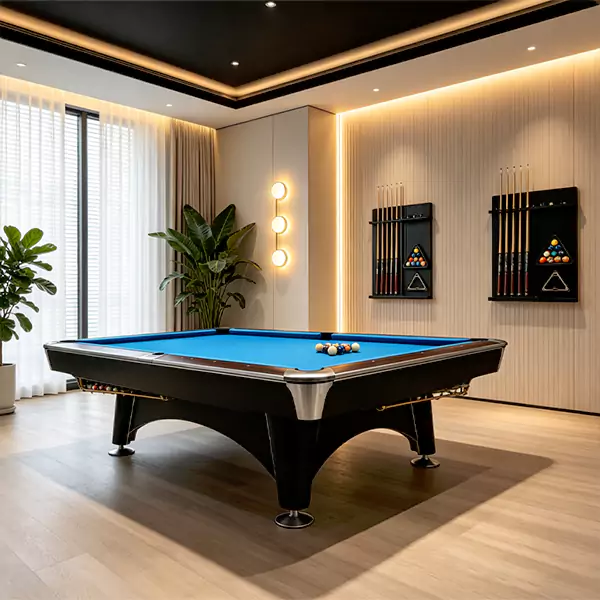


How Much Room Does a Pool Table Need?
Do not plan a room from the outside table dimensions alone. Start with the playing-field size, then add cue length on both sides. A standard full-length cue is about 58 inches, and extra circulation space is helpful where walls, chairs or columns are close to the shooting area.
Use this practical formula:
Minimum clear room dimension = playing-field dimension + two cue lengths
With 58-inch cues, the approximate clear space is:
| Table reference | Playing field | Approximate minimum clear room |
| 8ft | 92 x 46 in | 17ft 4in x 13ft 6in |
| 9ft | 100 x 50 in | 18ft 0in x 13ft 10in |
These are functional minimums, not ideal architectural targets. Add more space for spectator seating, cue racks, scoring, lighting access and player circulation. For multi-table clubs, also plan the distance between neighboring tables so players can cue simultaneously without interference.
Slate: The Foundation of True Ball Roll
Slate quality affects every shot. A rigid natural-stone bed resists local dips and vibration, while a multi-piece system allows international shipping and fine leveling during installation.
BOJUE’s American pool product pages commonly specify 25 mm, three-piece Jiujiang slate. Models such as the ONYX add a steel support structure, while the American Classic models use solid Thai oak frames. In both cases, the installation team must level the slate sections into a single plane and finish the seams correctly.
The WPA recommended equipment specification for sanctioned competition tables calls for slate at least 1 inch (25.4 mm) thick and sets detailed tolerances for flatness, loaded deflection and slate-joint alignment. BOJUE’s listed 25 mm commercial specification and the WPA’s 25.4 mm minimum are close but not identical. Buyers purchasing for a specific sanctioned event should therefore confirm the governing body’s requirements instead of relying only on marketing terms such as “tournament-grade.”
Ask a supplier:
- Is the bed natural slate or a synthetic board?
- How many slate pieces are supplied?
- What is the actual finished thickness?
- How is each piece ground and inspected?
- What leveling system supports the slate?
- Are installation tools and technical instructions included?
Why K55 Cushions Matter
The cushion turns speed into rebound. If rubber density, profile or installation varies, banks become difficult to read and cue-ball routes change from rail to rail.
Many BOJUE American pool tables use Black Premier K55 cushions. K55 describes the profile; the quality of the rubber compound and the accuracy of installation still determine the final playing result. Correctly fitted cushions should provide:
- Consistent rebound along all six rails
- Predictable bank and kick angles
- Stable elasticity over extended commercial use
- Clean contact without rail buzz or dead zones
- Reliable cue-ball response at different speeds
A commercial buyer should test more than a single hard bank. Compare slow, medium and firm rebounds along multiple positions on every rail.
Solid-Wood Frame or Steel Frame?
Neither construction is automatically best for every venue.
Solid Thai oak for traditional appearance
The American Classic 4th Gen and 6th Gen use solid Thai oak construction with HPL protection on high-wear surfaces. This approach combines the warmth of wood with a scratch- and moisture-resistant outer finish. It suits classic pool halls, homes, hotels and distributors seeking a familiar American design.
The 4th Gen adds chrome corner protection, laser-etched side branding and an integrated ball tray. The 6th Gen emphasizes iconic pool-hall styling and is available in 8ft and 9ft configurations.
Steel structure for intensive commercial operation
The BOJUE ONYX 9ft Competition Table uses a steel frame, leg beam and legs. This moisture-resistant structure is aimed at high-traffic clubs, training venues and markets where humidity makes structural stability especially important.
Steel does not eliminate the need for leveling or correct installation. Its advantage is a rigid, durable support system that can withstand continuous commercial use.
HPL Protection: A Practical Commercial Feature
High-pressure laminate is not simply decorative. On cushion rails, aprons and legs, it protects the underlying structure against scratches, moisture, chalk residue and routine cleaning.
For a private table played a few hours per week, exposed premium timber can be an attractive choice. For a busy club, HPL often lowers the cost of ownership by keeping high-contact surfaces presentable for longer.
Inspect how the laminate is applied at edges and corners. Good material with poor edge finishing can still lift or chip under repeated impact.
Pocket Openings and Ball-Return Systems
American pockets are generally wider and more angular than Heyball pockets. They are designed to accept speed and a broader range of entry angles, supporting the attacking style associated with 8-ball, 9-ball and 10-ball.
BOJUE lists the ONYX with 11.5 cm corner pockets and 12.5 cm side pockets. Buyers should compare pocket measurements only when the measurement method is identical. Mouth width, facing angle, shelf depth and pocket liner design all affect difficulty.
The collection also supports different ball-handling systems:
- Drop pockets:simple, quiet and suitable for many homes.
- Central ball return:speeds rack setup in clubs and commercial venues.
- Coin-operated return:monetizes play and reduces staff involvement.
Before ordering, confirm access for cleaning and maintenance. A ball return that cannot be opened easily can turn a minor blockage into unnecessary downtime.
Cloth, Lighting and Venue Experience
Cloth affects ball speed, spin response and maintenance. BOJUE product pages list options including PNS, Andy and CPBA cloth on selected models. Choose according to target speed, local availability and the operator’s cleaning routine rather than color alone.
Lighting also influences perceived quality. The BOJUE OPAL LED 9ft Table integrates adjustable color lighting into a competition-oriented table. BOJUE states that the OPAL served as the TV table at its 2025 Indonesia 880 million rupiah event, positioning it for clubs, events and hospitality venues that need both playing performance and visual identity.
Ambient LEDs do not replace a properly positioned overhead table light. The playing surface still needs even illumination with minimal glare and shadow.
Which BOJUE American Pool Table Fits Your Project?
| Project | Recommended BOJUE direction | Why it fits | Key question |
| Pub or self-service venue | Coin-Operated 7ft | Compact footprint and revenue mechanism | Which coins or tokens must it accept? |
| Home or hotel | American Classic 6th Gen 8ft | Balanced size and traditional styling | Does the room provide full cue clearance? |
| Classic commercial room | American Classic 4th or 6th Gen 9ft | Thai oak, HPL protection and familiar design | Ball tray, return and finish preference? |
| High-traffic billiard club | ONYX 9ft | Steel structure and commercial positioning | Humidity, daily hours and installation plan? |
| Premium event or entertainment venue | OPAL LED 9ft | Competition-scale play plus visual differentiation | Brand colors and lighting controls? |
| Distributor or private-label brand | Diamond Classic, Acurra or OEM range | Custom logo, finish and specification options | Target market, MOQ and compliance needs? |
Explore the complete BOJUE US Pool collection before requesting a quotation. A short project brief with room size, usage, desired table size, climate, ball-handling system and branding requirements will produce a much more accurate proposal.
What Commercial Buyers Should Check Before Ordering
For clubs, distributors and hospitality projects, purchase price is only one part of cost. Evaluate:
- Usage intensity:Estimate daily playing hours and peak customer turnover.
- Climate:Humidity and temperature affect wood, cloth and leveling stability.
- Service access:Confirm how cloth, cushions, pockets and ball returns can be maintained.
- Installation:Identify local installers or request factory guidance before shipment.
- Spare parts:Order compatible pocket liners, cloth and wear components with the first shipment.
- Packaging:Confirm protective wooden-case packing and container loading plans.
- Customization:Approve color, cloth, logo position and finish using drawings or a sample.
- Compliance:Match the final specification to any league, federation, venue or electrical requirement in the destination market.
Why Work with a Pool Table Manufacturer?
Buying directly from a manufacturer is especially valuable when a project needs multiple tables or a branded product line. BOJUE states that it was established in 1998, operates a 30,000-square-meter factory in Jiujiang and has annual capacity of 10,000 billiard tables. Its website lists American pool, Heyball, snooker, Russian Pyramid, carom and home tables, giving OEM buyers access to a broad engineering and supply base.
Available customization across the American pool range includes table size, color, cloth, frame material, logo, lighting and packaging. The important step is to turn those options into a controlled specification: approved drawing, bill of materials, sample standard, packaging plan and quality checkpoints.


Final Recommendation
Choose an American pool table by use case, not appearance alone.
- Select 7ftwhen space efficiency, casual play and coin operation lead the decision.
- Select 8ftwhen a home or hotel needs a serious table without the room requirement of a 9ft model.
- Select 9ftfor clubs, academies and competition-focused play.
- Choose solid Thai oak with HPLfor classic presentation and commercial surface protection.
- Choose a steel-supported modelwhen intensive use and moisture resistance are central concerns.
- Confirm slate thickness, cushion profile, pocket geometry and installation requirementsin writing before production.
A well-specified table should remain level, rebound consistently, tolerate its operating environment and fit the business model of the venue. That is the difference between simply buying a billiard table and investing in a reliable playing platform.
View BOJUE [American pool tables](https://www.bojuebilliard.com/us-pool/) or [contact the factory](https://www.bojuebilliard.com/contact-us/) for club, hotel, distribution and OEM quotations.
Frequently Asked Questions
- Is a 7ft, 8ft or 9ft pool table best?
A 7ft table is best for compact bars and coin operation, an 8ft table balances room size with serious play, and a 9ft table is the preferred choice for competition-focused clubs and training. - What is the standard playing surface of a 9ft pool table?
The WPA recommended equipment specification lists a 9ft playing surface of 100 x 50 inches inside the cushions. Always confirm the manufacturer’s actual drawing before planning a room. - Is a 25 mm slate the same as one inch?
Not exactly. One inch equals 25.4 mm. BOJUE American pool product pages commonly list 25 mm slate, while the WPA recommended specification for sanctioned competition equipment lists at least one inch. Buyers purchasing for a governed event should confirm the applicable requirement. - What does K55 mean on a pool table?
K55 describes a cushion-rubber profile commonly used on American pool tables. Rebound quality also depends on the rubber compound, rail construction and installation accuracy. - Is a steel-frame pool table better than a wood-frame table?
Steel offers high rigidity and moisture resistance for intensive commercial use. Solid wood offers a traditional appearance and can also be highly stable when correctly engineered. The best choice depends on climate, venue design, service needs and expected playing hours. - Can BOJUE customize American pool tables for distributors?
Yes. BOJUE lists OEM and ODM options including size, finish, cloth, logo, materials, lighting and packaging. Confirm the final scope, MOQ, lead time and approved sample directly with the factory.