

What Is a Carom Table? Why This 9ft Billiard Table Has No Pockets
A carom table looks unfinished to someone who expects six pockets. In fact, the pocketless design is the entire point. Carom billiards is played by controlling contact among three balls and the cushions, so the table is engineered around flatness, speed and repeatable rebound rather than pocket acceptance.
This difference changes everything: the cushion is an active scoring surface, the cloth must support long routes, and optional heating can help maintain consistent rolling conditions. For clubs, academies, hotels and serious home players, choosing a carom table therefore requires a different checklist from buying an American pool, Heyball or snooker table.
Quick Answer: What Is a Carom Table?
A carom table is a pocketless billiard table used for disciplines including straight rail, balkline, one-cushion and three-cushion billiards. A typical game uses three balls: one cue ball for each player and one red object ball.
Under the UMB world rules, a carom is scored when the shooter’s cue ball contacts both other balls in a valid stroke. In three-cushion billiards, the cue ball must contact at least three cushions before it reaches the second object ball.
Because there are no pockets, success depends on predicting angles, speed, spin and multiple cushion contacts. This makes the consistency of every rail central to the game.
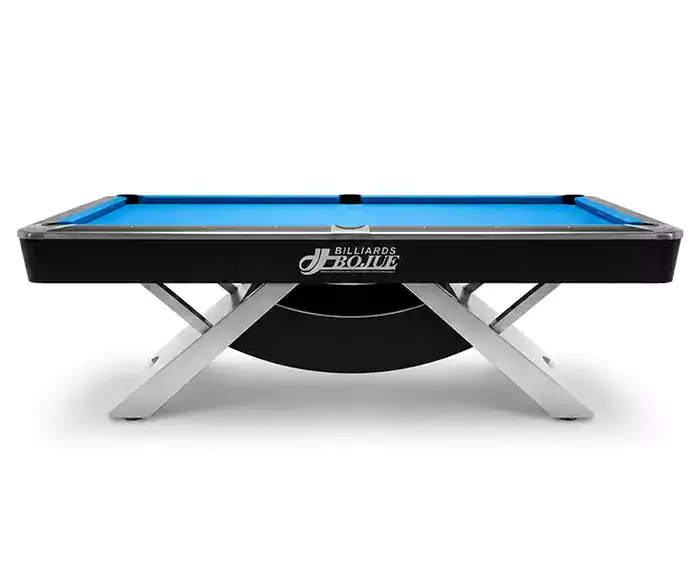 ONYX 9ft Competition Billiard Table
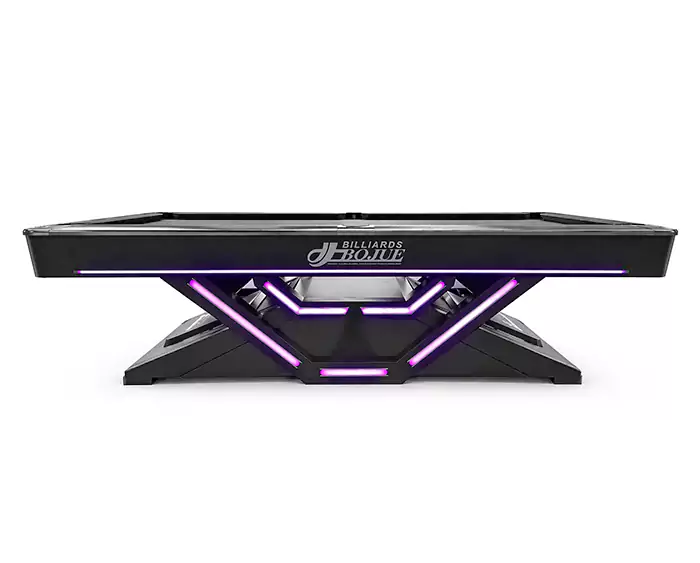 SHADOW 9ft Billiard Table
 9ft American 6Gen diamond Style Billiard Table
Carom vs Pool, Heyball and Snooker
| Feature | Carom billiards | American pool | Heyball | Snooker |
| Pockets | None | Six, angular jaws | Six, rounded jaws | Six, rounded jaws |
| Typical objective | Contact both object balls; cushion conditions vary by discipline | Pocket numbered or object balls | Pocket colored groups using Chinese 8-ball rules | Score with reds and colors |
| Balls | Three larger carom balls | Usually 57.2 mm set | Commonly 57.2 mm set | 52.5 mm set |
| Main table challenge | Cushion routes and precise position | Pocketing plus position | Tight pocket acceptance plus position | Long potting and tactical safety |
| Common full-size field | UMB: 2.84 x 1.42 m | 9ft reference: 100 x 50 in | Model and event dependent | Full-size: 12ft class |
These formats are not interchangeable. Removing pockets from a pool table does not create a competition-ready carom table: cushion geometry, playing field, cloth, balls, slate support and heat management must work as one system.
Why Cushion Response Matters More Without Pockets
In pool, the cushions shape position and bank shots. In three-cushion billiards, cushion contact is built into the scoring requirement. A small inconsistency can change the final path over a long, multi-rail route.
A good carom table should deliver:
- Even rebound along the full length of every cushion
- Comparable response from rail to rail
- Stable cushion-nose height and attachment
- Clean low-speed response without dead zones
- Predictable behavior at different speeds and spin levels
The installer should test several paths, not only a single hard bank. Slow and medium-speed routes often reveal level or cushion problems that a fast shot can hide.
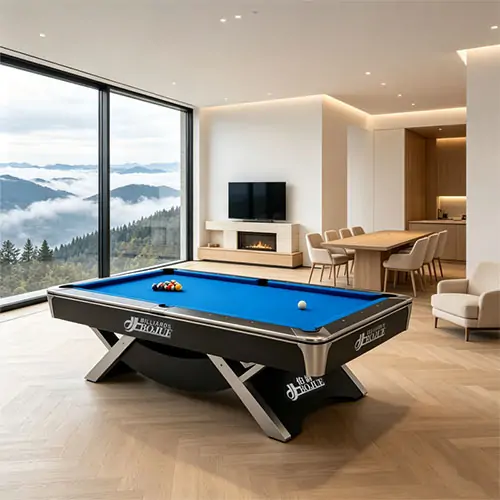
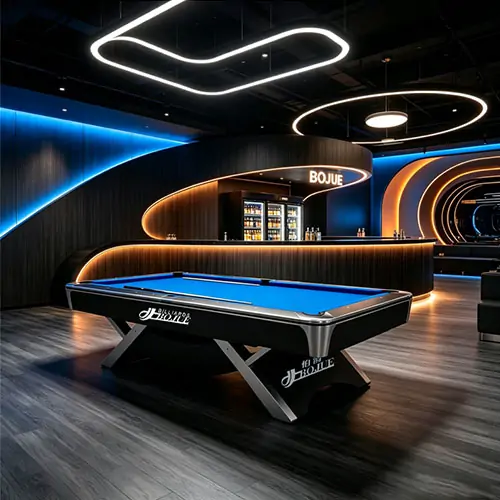
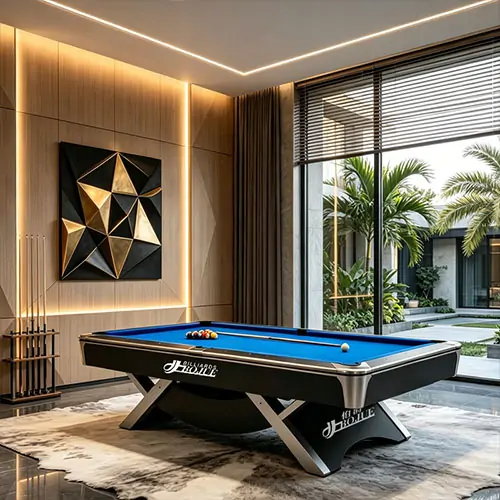
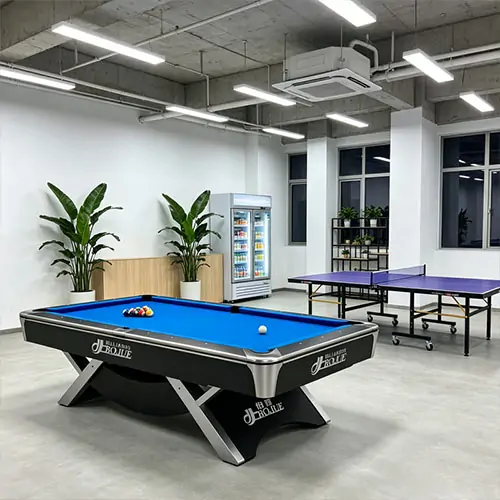
BOJUE 9ft Pocketless Carom Table: Listed Configuration
| Item | BOJUE website listing | Buyer note |
| Table type | 9ft pocketless carom table | Intended for carom disciplines |
| Playing area | Approximately 100 x 50 in / 254 x 127 cm | Confirm final drawing; smaller than the UMB 2.84 x 1.42 m official field |
| Overall size | Approximately 286 x 159 cm | Use for initial logistics and room planning |
| Balls | Three: red, white and yellow or spotted white | Standard carom game arrangement |
| Listed ball size | 61.5 mm; 205-220 g | Falls within the UMB ball range; confirm supplied set |
| Playing system | Premium slate, responsive cushions and carom cloth | Request final material schedule |
| Heating | Optional | Useful for moisture control and consistent rolling conditions |
| Customization | Color, cloth, logo, materials and heating; OEM/ODM | Suitable for clubs, projects and distributors |
BOJUE describes this as a competition-oriented product. Its listed 254 x 127 cm playing area is not the same as the UMB official free playing surface of 2.84 x 1.42 m. Buyers sourcing tables for a sanctioned competition must give the factory the exact governing specification and obtain written dimensional approval before production.
Product Size vs Official Tournament Specification
The phrase “9ft carom table” can describe a commercial product class, but it should not be treated as automatic proof of compliance with every federation or event.
The UMB World Rules of Carom Billiard specify an official free playing surface of 2.84 x 1.42 m, a slate bed at least 45 mm thick, cushion nose height of 37 mm with stated tolerance, and table height between 75 and 80 cm. The rules also require an electrical heater with thermostat for tables intended for official tournaments.
That does not make a smaller 9ft model unsuitable. A 100 x 50 in pocketless table may be attractive for training, private use, hospitality or venues with restricted space. It simply serves a different specification unless the buyer and governing organization approve otherwise.
Use three labels carefully:
- Pocketless carom table:describes the game format.
- Competition-oriented:describes design intent or playing character.
- Federation-compliant tournament table:should be used only after every applicable requirement is verified.
Why Some Carom Tables Use Heating
Moisture in slate and cloth changes friction and can slow the balls. A heating system gently warms the playing bed, helping reduce humidity and maintain more stable rolling conditions.
The UMB rules state that tables used for official tournaments are equipped with a thermostatically controlled electrical heater to eliminate humidity from slate and cloth. BOJUE lists heating as an optional configuration on its 9ft carom product.
When ordering heating, confirm:
- Destination voltage and frequency
- Plug, cable and grounding requirements
- Thermostat range and control location
- Power consumption
- Electrical certification required in the destination market
- Installer and maintenance responsibilities
Heating supports consistency, but it cannot correct an uneven slate, poorly installed cloth or inconsistent cushions.
Slate, Cloth and Ball Selection
Carom shots can travel the full length of the table several times. The playing bed must therefore be rigid, accurately joined and precisely leveled. Ask for the slate thickness, number of pieces, support structure and leveling method on the final quotation.
Carom cloth is selected for speed and repeatable response. Keep it clean using the cloth manufacturer’s recommended method and control chalk accumulation near the rails. A cloth change may alter speed enough that regular players need time to recalibrate their routes.
BOJUE’s specification table lists 61.5 mm balls weighing 205-220 g. The UMB rules specify three balls with a diameter between 61 and 61.5 mm and weight between 205 and 220 g. Buyers should still confirm the brand, tolerance and approval status required for their competition or federation.
How Much Room Does a Carom Table Need?
Start with the playing-field drawing, then add one full cue length at every side. A common planning method is:
Minimum clear room dimension = playing-field dimension + two cue lengths
For BOJUE’s listed 254 x 127 cm playing area and a 147 cm cue, the functional clear area is approximately 548 x 421 cm. This is a shooting minimum, not an ideal venue layout.
Add more space for:
- Spectator seating and circulation
- Scoreboards and referee position
- Cue racks and storage
- Overhead lighting access
- Heating controls and electrical service
- Maintenance access around the cabinet
- Separation between multiple tables
Use the final factory drawing for architectural work. Overall cabinet size, rail width and leg position can change the installation plan.
Who Should Choose a 9ft Pocketless Table?
A 9ft carom table can be an appropriate choice for:
- Clubs introducing straight-rail or three-cushion play
- Training academies with space constraints
- Hotels and resorts offering multiple cue-sport formats
- Premium private game rooms
- Universities and recreation centers
- Distributors testing demand for pocketless tables
Buyers preparing for official UMB events should instead begin with the current event specification and request a fully compliant build. The intended use determines whether compactness or federation dimensions should lead the decision.
Installation and Maintenance Checklist
Before delivery
- Verify doorways, lifts, stairs and floor loading.
- Approve the playing field, overall dimensions and leg positions.
- Confirm electrical requirements if heating is ordered.
- Plan an even overhead lighting system.
- Identify an installer experienced with carom tables.
During installation
- Level the frame and every slate section.
- Finish slate seams so they do not affect roll.
- Tension and fit the cloth consistently.
- Confirm cushion alignment and height.
- Test slow rolls and multi-cushion routes.
- Commission the heater and thermostat safely.
In operation
- Clean cloth and balls using approved methods.
- Monitor room humidity and temperature.
- Test cushion response at several rail positions.
- Recheck level after relocation or floor movement.
- Keep heating controls, cables and ventilation unobstructed.
Final Buying Recommendation
Choose a pocketless carom table because you want the geometry and three-ball discipline of carom billiards, not simply because it looks distinctive. Prioritize flatness, cushion uniformity, cloth behavior, ball specification and expert installation.
BOJUE’s 9ft model offers a compact 100 x 50 in listed playing field, a three-ball configuration, customization and optional heating. It can suit training, clubs, hospitality and private projects where that size is intentional. For sanctioned competition use, specify the governing standard in the purchase contract; the UMB official field and equipment requirements differ from this listed product size.
View the [BOJUE 9ft Pocketless Carom Table](https://www.bojuebilliard.com/carom-table-9ft-pocketless-tournament-grade/) or [contact BOJUE](https://www.bojuebilliard.com/contact-us/) to discuss dimensions, heating, customization and OEM projects.
Frequently Asked Questions
- Why does a carom table have no pockets?
Carom billiards scores contact between balls rather than pocketing. The pocketless field allows long, controlled routes involving cushions, speed and spin. - How many balls are used in carom billiards?
Three balls are used: a cue ball for each player and one red object ball. One cue ball is normally yellow or marked so the players’ balls can be distinguished. - What is the difference between carom and three-cushion billiards?
Carom is the broader family of pocketless games. In three-cushion, the cue ball must contact at least three cushions before contacting the second object ball for a valid point. - Does every carom table need heating?
Not every recreational table needs it. Heating helps control moisture and improve consistency, and UMB rules require thermostatic heating for tables intended for official tournaments. - Is the BOJUE 9ft carom table UMB tournament size?
The product page lists a 254 x 127 cm playing area. The UMB official free playing surface is 2.84 x 1.42 m, so they are not the same size. Confirm the required standard before ordering for a sanctioned event. - Can BOJUE customize a carom table?
BOJUE lists customization for color, cloth, logo, materials and optional heating, with OEM/ODM support. Final specifications, approvals, MOQ and lead time should be agreed with the factory.